The architect
Les Furber: the western Canadian architect behind Hyde Mountain
Fifty-plus courses across three provinces, a spell with Robert Trent Jones, and a recognisable way of using a hillside.
- Practice
- GDS Golf Design Services
- Based
- Canmore, Alberta
- Courses
- 50+ in the west
- This one
- Opened 2002
The architect behind the routing
Les Furber designed the course above Mara Lake, which opened in 2002. He is not a household name outside western Canada, and inside it he is close to unavoidable — his practice, GDS Golf Design Services, has produced more than fifty courses across British Columbia, Alberta and Saskatchewan, along with work further east and abroad.
Furber’s background is the part that explains the rest. He worked for Robert Trent Jones until 1980, then set up on his own in Canmore, Alberta, and built a career on mountain and foothills sites — the kind of terrain a lot of architects would rather not be handed. The stated philosophy is unfussy: a course should be enjoyable to design, to build and to play for golfers of every standard. In practice that translates into routings that use severe ground without punishing the average player for being on it.
The better-known courses
Several of the layouts most often named in any discussion of western Canadian golf are his:
- Predator Ridge — above Vernon, the best known of the group and the closest thing to a resort-scale Furber design.
- Gallagher’s Canyon — Kelowna, cut through the canyon terrain the name suggests.
- Trickle Creek — Kimberley, in the Purcells; the closest in character to the Mara Lake course.
- The Springs at Radium — the Columbia Valley.
- St. Eugene — near Cranbrook, on the Mission site.
- Silvertip — Canmore, and about as vertical as Canadian golf gets.
The list continues well past the famous ones. Furber work turns up around Vancouver at Northlands, Mayfair Lakes and Riverway, and across Vancouver Island at Morningstar, Fairwinds and Storey Creek — parkland and seaside sites that look nothing like the mountain courses and are recognisably by the same hand once you have played a few.
What the mountain routings have in common
Play two or three of them and a pattern emerges. Furber tends to take the elevation change as the primary design feature rather than engineering it away, which is why so many of his holes are played from a tee well above or well below the landing area. He is generous off the tee on the holes where the ground is severe, and tightens the demands at the green instead — several of the courses share the habit of a wide fairway followed by an approach where club selection is the entire problem.
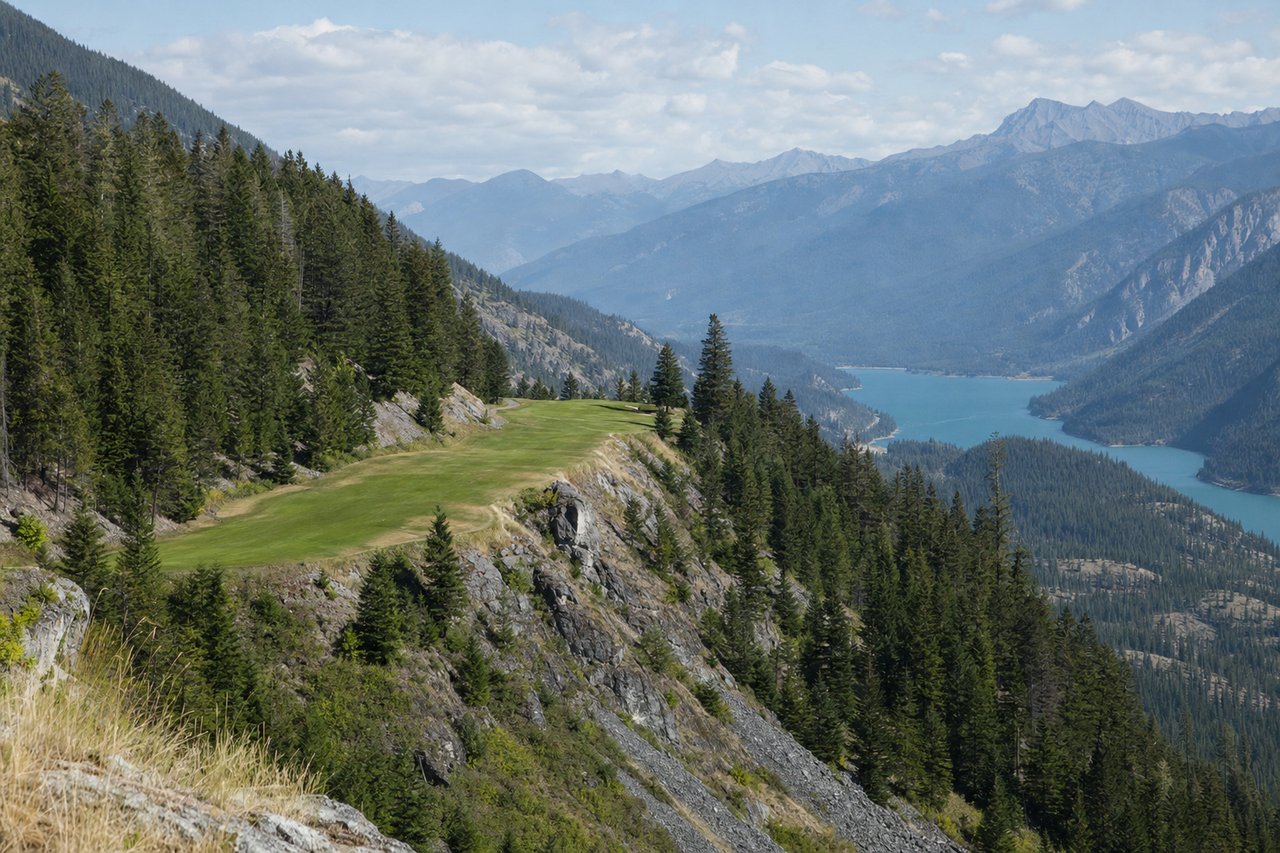
The Mara Lake course is a compact example of all of it. The fourth drops 260 feet from tee to landing area and is played as a feature rather than a hazard, with a local rule allowing a single tee shot and a drop area for the ball that does not survive the journey. The fifth is a 380-yard par 4 rated the hardest hole on the card, entirely because of an uphill approach to a raised green. Neither hole would be interesting on flat ground; both work because the ground is not flat.
Playing two Furber designs in a weekend
The Champions Course at Salmon Arm Golf Club is also his, also built into a hillside, and thirty minutes west. At 6,738 yards it is marginally longer than the Mara Lake course and runs through mature fir, cedar and pine rather than open slope, which makes the pair a useful comparison: the same design instincts applied to two quite different sites within half an hour of each other.
Predator Ridge, above Vernon, is about an hour and a quarter south and completes a reasonable three-course weekend for anyone who wants to see the range — resort scale, hillside parkland and compact mountain, all by the same architect. The Shuswap golf page covers the logistics, and the scorecard sets out how the Mara Lake routing plays hole by hole.
How to recognise a Furber hole
There is no signature bunker shape or trademark green complex to look for, which is part of why the name travels less than the courses do. What repeats is a set of decisions rather than a set of forms.
The first is that the tee is usually placed to sell the view. On a site with elevation, Furber tends to put the teeing ground where the ground falls away, so the hole reveals itself all at once instead of unfolding. The fourth above Mara Lake is the extreme version of that habit; the seventeenth is the same idea at a smaller scale.
The second is generosity where the ground is hardest. On the holes with the most severe terrain, the landing areas are wide — the difficulty has been moved to the approach and the green rather than stacked on top of an already awkward tee shot. The fifth here is the clearest case: a modest 380 yards, plenty of room off the tee, and a raised green that turns the second shot into the whole hole.
The third is that greens are asked to do the defending. Two-tier surfaces, pronounced ridges, run-offs that move the ball predictably in one direction — all of it means club selection and shot shape matter more than raw distance. It is why his courses tend to be described as fair by good players and demanding by everyone else, and why they hold up on a short season where conditioning cannot be relied on to provide the challenge.
Questions about Les Furber
Who designed Hyde Mountain on Mara Lake?
Les Furber, whose practice GDS Golf Design Services is based in Canmore, Alberta. The course opened in 2002 and now runs as Mara Hills Golf Resort.
How many courses has Les Furber designed?
More than fifty across British Columbia, Alberta and Saskatchewan alone, with further work elsewhere in Canada and internationally. He founded his own practice in 1980 after working for Robert Trent Jones.
What are his best-known courses?
Predator Ridge near Vernon, Gallagher’s Canyon in Kelowna, Trickle Creek at Kimberley, The Springs at Radium, St. Eugene near Cranbrook and Silvertip at Canmore are the ones named most often.
Which other Furber course is nearest?
The Champions Course at Salmon Arm Golf Club, thirty minutes west — 6,738 yards, par 72, and another hillside routing. Predator Ridge is the next nearest at about an hour and a quarter.
What characterises his design style?
Using severe terrain as the feature rather than flattening it, generous landing areas on the holes where the ground is hardest, and greens that make club selection the main defence. The result is playable for a mid-handicapper while still asking questions of a good player.