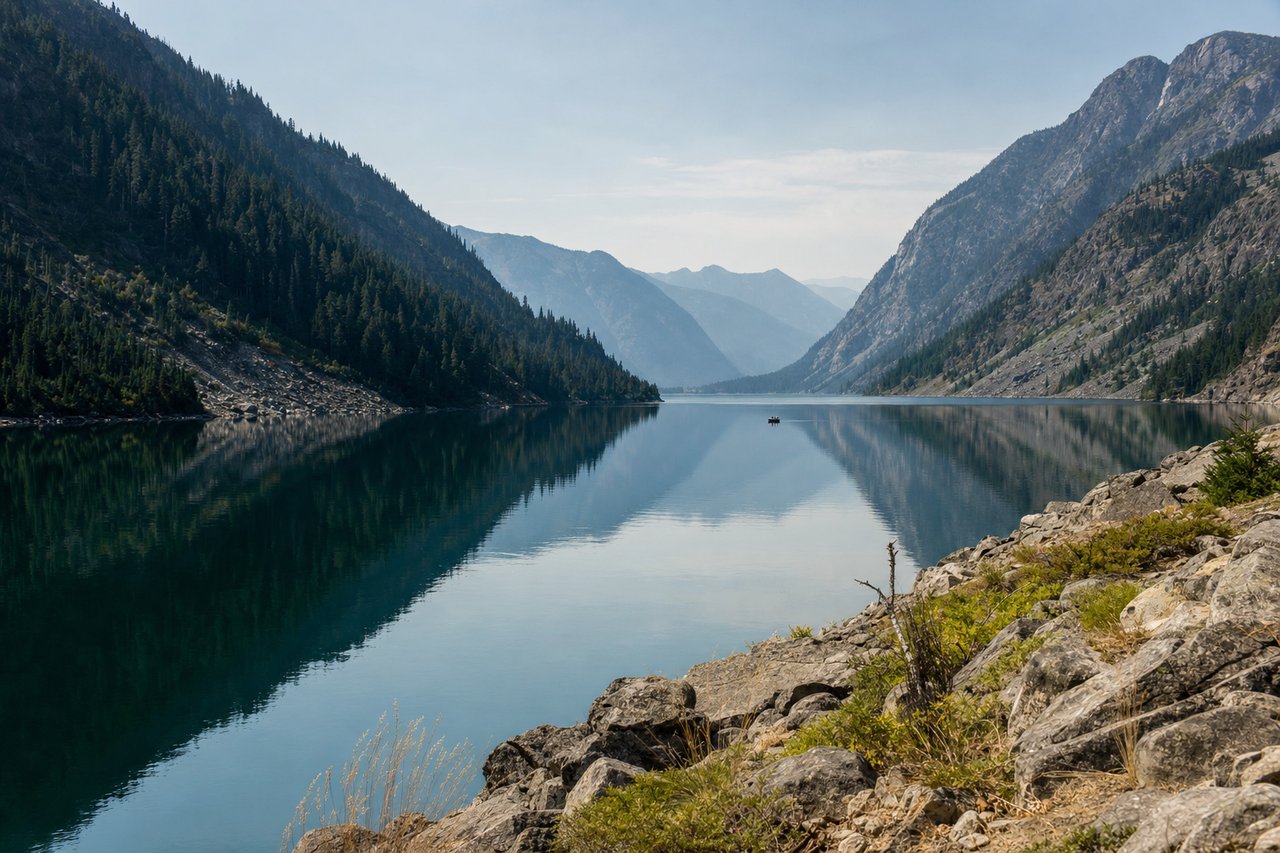
The water
Mara Lake: boating, the marina and beaches south of Sicamous
The narrow lake running south from the channel, and the reason half the town owns a boat.
- Length
- ~19 km
- Joins
- Shuswap Lake
- Season
- Late May to September
- Warmest
- August
The lake below the course
Mara Lake runs about nineteen kilometres south from Sicamous toward Grindrod, narrow enough that both shores are always in view and deep enough to stay cold under a warm surface layer. It connects to Shuswap Lake through the channel at Sicamous, which makes the two effectively one navigable system and explains why a town of 2,400 people supports the houseboat fleets it does.
The lake gives its name to the small community of Mara BC further south toward Grindrod, and to most of the accommodation along this shore — a search for a Mara Lake resort turns up cabin operations and RV parks rather than anything resembling a hotel. For golfers the relevant fact is orientation. The course occupies the eastern slope above the lake, so the water sits below the playing surface rather than beside it. That is why the views from the upper holes are as long as they are, and why the wind behaves the way it does — air moving over open water and then up a hillside does not arrive at a tee box in a straight line.
Boating and the marina
Houseboats are the reason most people come. Rental fleets operate out of the marinas along the channel in Sicamous, and a typical charter runs three to seven nights covering both Mara Lake and the arms of Shuswap Lake. Boats are provisioned in town before departure, and the standard advice from operators is to shop before you arrive at the dock rather than after.
Beyond houseboats the lake carries the full range: ski boats, wakeboarding, fishing, kayaks and paddleboards on the calmer mornings. Public launches and moorage are concentrated around the channel. The water is busiest in the middle of the day in July and August and genuinely quiet before about nine in the morning, which is the window paddlers use.
The marina area also holds the practical services — fuel, pump-out, repairs and the boat rental desks. It is a working harbour rather than a scenic one, and it is a short drive from the golf course rather than walking distance.
Beaches and swimming
Mara Lake has the warmest accessible swimming in the immediate area, helped by its narrowness and its shallower southern end. The provincial park on the western shore is the main public access point, with a beach, day-use parking and a boat launch. There are smaller pull-offs along the highway on the way south toward Grindrod, several of which are locals’ spots rather than signed facilities.
Surface temperature climbs through July and peaks in August. Early season swimming here is a bracing proposition — the lake is fed by snowmelt and the deep water stays cold all summer regardless of what the top two metres are doing.
The season on the water
Boating runs from roughly late May to late September, with the houseboat charter season concentrated in July and August. Shoulder weeks in June and September are the ones experienced visitors book: the water is still comfortable, the fleets are not fully out, and the same is true of the golf course on the hillside above.
Winter empties the lake. It does not freeze reliably enough for ice activity, the fleets are hauled out, and the town shifts to snowmobiling and the ski hill at Revelstoke an hour east. Anyone visiting Sicamous between November and March should plan around the highway rather than the water — details are on the Sicamous page, and the tee times page covers when the course reopens.
Fishing and getting on the water without a boat
Mara Lake fishes for rainbow trout, lake trout, kokanee and burbot, with whitefish through the colder months. It is not a destination fishery in the way some of the smaller interior lakes are — the water is deep, the fish are scattered, and most success comes from trolling rather than casting from shore. A British Columbia freshwater licence is required, regulations vary by species and season, and both are worth checking against the current provincial synopsis rather than local advice, because the rules on this system have changed more than once.
Without a boat there is still plenty of access. The provincial park beach on the western shore is the main public entry point, and the rail trail sections near town put you alongside the water on foot or by bicycle. Paddleboards and kayaks can be rented in Sicamous through the summer, and the sheltered water at the northern end near the channel is the sensible place to use them — the middle of the lake gets a genuine chop once the afternoon wind and the boat traffic pick up together.
One practical warning for anyone swimming or paddling in July and August: this is a busy motorised lake with houseboats, ski boats and personal watercraft sharing narrow water. Stay inside marked swimming areas where they exist, and keep close to shore where they do not.
Questions about Mara Lake
How big is Mara Lake?
About nineteen kilometres long and narrow throughout, running south from the channel at Sicamous toward Grindrod. It joins Shuswap Lake at that channel, so the two are navigable as one system.
Can you swim in it?
Yes, and it is among the warmer swimming water in the region by August. The provincial park on the western shore is the main public beach and day-use area. Early in the season it is cold — the lake is snowmelt-fed and only the surface layer warms.
Where do the houseboats come from?
The rental fleets are based at marinas along the channel in Sicamous, which holds the largest concentration of houseboat rentals in Canada. Charters typically run three to seven nights and cover both Mara Lake and the arms of Shuswap Lake.
Is the golf course on the lake?
Above it. The routing occupies the eastern hillside, so the lake is a view from most of the holes rather than a hazard on any of them. The elevation between the course and the water is what produces both the scenery and the club-selection problems.
When is the water busiest?
Midday through July and August. Mornings before about nine are quiet enough for paddling even in peak season, and the second half of September is quiet throughout.